
Conducting a Gap Analysis

This article addresses some findings of the gap analysis processes and provides a look at some of the healthcare industry experts that provide the direction and oversight of EvSOP.
Present State
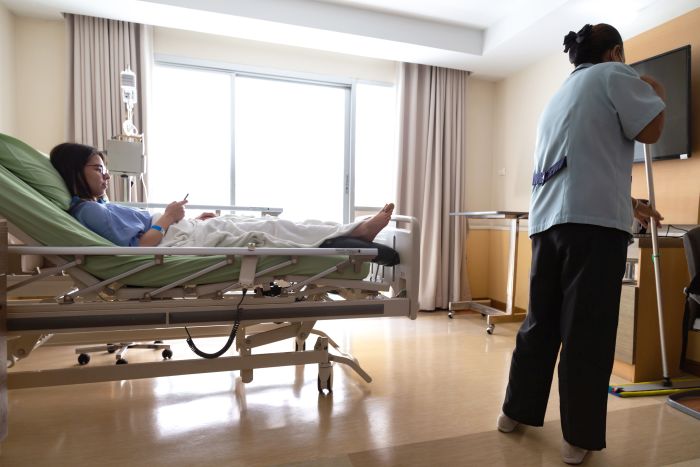
Patients are frequently left in waiting areas, without a bed, or waiting for a room. Although this often is unavoidable due to various reasons, when a EvSOP gap analysis is performed, one of the reasons usually traces back to patient rooms in need of environmental services (EVS) attention.
When budgets need tightening and even reducing, all too often EVS is the first department targeted since it is considered an “expense” department as it is not a revenue (think “income”) producing department. A challenge to the perspective held regarding income versus expense departments as regards to EVS is in order. For it is EVS that provides the most visual “face” of a healthcare facility. If EVS fails to fulfill its obligations, every other department suffers since patients and visitors are of the universal opinion that they know clean when they see it, even if they do not understand the process and protocols that need to be followed, they do recognize variations or differences and areas missed. Should EVS reduce its presence and efficacy due to personnel cuts, the perception of clean is the first casualty of budget reductions or cost-cutting initiatives. The reality of patients choosing other facilities will be a reality.
The reality of EVS departments is that they are investment departments. Without EVS, hospitals will soon, no, quickly close their doors.
During the numerous gap analysis surveys conducted, not only did EVS self-identify as being understaffed in critical patient care areas, other departments reported EVS as being understaffed. Nursing departments, infection prevention departments, and administration ESOP champions identified the reality of EVS understaffing.
The gap analysis surveys identified a lack of awareness and communication of that awareness that existed regarding the importance and value EVS provides in the role of patient care. The failure to perceive or acknowledge expertise exhibited by EVS in tending to the environment of care was recognized. That vital message resonated fully with healthcare executives or key opinion leaders (KOLs).
Communication was also lacking in need for resources when census levels increased, the demand placed upon the emergency department (ED), or in increased OR cases or types of patients presenting that required additional cleaning and disinfection in the ED. Other communication gaps presented obstacles when unexpected projects, at least unknown to EVS, began at facilities without consideration of requirements placed on the department that necessitated added staff to support the projects such as renovations and additions. That may sound implausible, but those situations arise much too often and are a result of a lack of communication, cooperation, and collaboration. Coincidentally, two study sites, one new and another with a significant addition of a 17-story building, did not include a seat at the table for EVS leaders to discuss the impact or role these initiatives would place on cleaning and disinfection. Whether intentional or a gross oversight due to a proliferation of a silo mentality is unknown. The new building sited in the gap analysis did not include consideration or the need for added dock space, waste-stream support, EVS storage, clean utility, or soiled utility rooms, or types of surfaces fabrics and equipment that could exist and function in a healthcare environment and reasonably cleaned and disinfected.
Additionally, although necessary for clinical staff support, no allocation of space for Scrub Dispensing equipment was considered nor available after the build further burdening the labor budget for non-essential patient care tasks.
The silo actions had a vital and negative impact on staffing and resources in EVS. They required significant time and effort by many departments to find creative ways to work around diminished space and lack of ready resources such as tools, equipment, and storage while failing to provide additional funding to meet the needs of many departments. At the same time, EVS and other departments experienced labor issues necessitated by transportation and time requirements due to the demand for moving both people and assets from one point to another.
Multiple analysis surveys addressed different impacts on EVS, and clinical staff directly responsible for patients. A lack of communication and understanding of task assignments was cited numerous times in the surveys. Failures to communicate between discipline responsibilities for what needed cleaning and who was responsible for cleaning, and when cleaning was required. Without a definite responsibility matrix, dirty equipment waited for the responsible party to clean, disinfect, and remove it. Without a distinct model, EVS ultimately inherits the responsibility of ensuring every item, in the room, is processed.
The project advisors assigned to the study sites observed two measurements of time:
(1) Wheels out to wheels in (a term to indicate when a patient leaves a room, to when another can come in), often referred to as Room Turnaround Time; and
(2) a more widely recognized and accepted measurement relative to EVS, Room Turnover Time, meaning the time it takes to process a discharged room.
Minimal Room Turnover Time was significantly evident and stressed for both patient room discharge and isolation room cleaning, as well as OR in-between case cleaning and end of day terminal cleaning in the Operating Room. Numerous surveys indicated continual pressure to reduce processing time which resulted in undue influence upon staff to incompletely fulfill the necessary tasks that provide hygienic spaces for patients. Infection preventionists recognize the practice is unsafe and indicated they strive to support the needs of EVS in adequately fulfilling their duties and responsibilities to both patients and nursing staff.
Improved Outcomes
Through the implementation of the ESOP program, executive-level leadership was engaged immediately through an invitation to join as an Executive Sponsor. Minimal time is requested to invest in the overall project, except for the necessary project kickoff and post-project report. The Executive Sponsors participate in the program whenever they wish and when influence is required, or deemed necessary, to remove roadblocks encountered or facilitate collaboration and resource allocation.
Communication within the multidisciplinary team incorporates a simple template that allows the departments a method and means to validate effective communication, report changes, monitor infection rates, and gain collaboration. Value Analysis teams, if not already functioning, is set in place that allows regular and thoughtful communication. And involvement in projects and purchasing of products or services are performed by a team of vested stakeholders. The Value Analysis teams ensure that all purchases meet the requirements of the facility, as well as proper infection prevention and environmental service cleaning and disinfection guidelines.
Penn Medicine and Children’s Hospital of Philadelphia infection preventionists Caroline Haggerty and Sara Townsend respectively enacted a “Who Cleans What, How, and When” program. The program facilitated education and buy-in to ensure that everyone was clear on the manufacturer’s instructions for use (IFU). Aka: The IFU’s, proper cleaning and disinfection, coupled with a responsibility matrix and utilization of AHE’s Certified Surgical Cleaning Technician certification training (CSCT), and Certificate of Mastery of Infection Prevention (CMIP) along with a capstone project ensured each item was adequately cared for to provide the best patient care.
Training – Evidenced Based Certification
Present State
There was a variety of programs in place for both in-house (hospital managed) and contractor (outsourced) training; however, standardized resources across facilities lacked the requisite methods and means to fulfill obligations and the equipment varied. The content of the existing programs typically was outdated to current industry standards and the latest practice guidance by the authorities having jurisdiction. Policies were outdated, including the training materials and resources on-hand. In many cases, the passion and desire to serve were evident, yet the tools, knowledge, availability, or time, and financial support was lacking.
Improved Outcomes
As introduced last month, the Association Healthcare Environment (AHE) was available to program participants to provide significant resources. Resources included instructor-lead train the trainer programs with world-class content. The AHE was ready to deliver educational formats for audiences to make an immediate impact on patient care involved in the program. Through extensive research and comparative analysis, AHE training proved to be the best program available in the market today for program participants. The training delivers thoughtful and practical solutions that effect the best patient outcomes possible, as well as quality and reduced cost of care.
During the EvSOP roll-out, participating study sites were able to be assigned an advisor with extensive experience and knowledge to help support identified gaps or areas agreed upon to focus on, thereby helping implement necessary resources to drive long term sustaining gains. Advisor participation continues to be a precious resource to ESOP sites and remains as a benefit to new program sites.
Quality
Present State
William Rutala said it best to have good patient outcomes, one must start with Good Products and Good Processes (Training). No one can be gifted with a Ferrari and become a professional driver without the necessary instruction, training, and guidance. Ongoing support and coaching are also essential. Coaching requires actively engaged leaders inspecting the expected. Coaching involves direct observation and effective rounding. Getting out of the office and observing the principles of the GEMBA walk.
Too often, EVS departments had inadequate equipment, broken, misplaced, worn out, or inappropriate materials and tools for the job at hand. That is akin to expecting a surgeon to perform heart surgery with a butter knife and a pair of pliers. EVS’s role in patient care is to promote a hygienic and healing environment.
This role requires wipes and mops that are appropriate for the healthcare setting to clean and disinfect, and have the capability to work on the surface intended without adverse effects on the targeted surfaces or equipment. Wipes and mops must be compatible with EPA-registered healthcare-grade disinfectants, effectively remove bioburden from the surfaces, and remove the dry surface biofilm (DSB). Wipes and mops must effectively remove residual endotoxins left by disinfectants and ineffective or poor-quality, so-called microfiber. Mops and wipes must also be capable of removing and not re-depositing residue that typically leaves surfaces appearing turbid- dirty, cloudy, streaked, and sticky (usually from certain disinfectant solutions), and that negatively impact patient-experience scores.
Improved Outcomes
Through the EvSOP Advisory Board, leaders in healthcare regularly convene via teleconferences to discuss the gaps in industry products, processes, and outcomes.
One teleconference highlighted that science-based definitions were nonexistent for many commonly used terms and products, thus causing many undesired consequences. For example, after an extensive search of available products for wiping and mopping, and working with the manufacturers and distributors to ascertain intended use while looking at available innovative research and design for future products under development, a matrix was created to evaluate performance characteristics as appropriate for a healthcare setting. These criteria (shown below) demonstrated missing definitions upon which to assess all products for best patient outcomes, efficacy, quality, and overall costs.
The Gap analysis determined incorrect product applications according to manufacturer Instructions – IFU’s, proper reprocessing or laundry and care instructions, life-cycle analysis, that is, when to replace products.
Definitions of what constituted a microfiber product varied considerably, within both disposable and reusable products, much like calling all modes of transportation automobiles, without respect to the desired outcome. Definitions of research laboratories and facilities varied greatly, and most testing was done to manufacturer expectations, not necessarily what was best for clinical outcomes, impact to the healthcare worker physically or ergonomically, resource management, expense, and local environmental impact.
The definitions of what constituted proper laundering and reprocessing to meet CDC and CMS guidelines were not clear. Additionally, even when aware of the guidelines, it was often ignored or needed to be clarified and evaluated by third-party organizations to ensure appropriate adherence to processing protocols.
Every journey begins with the first step, and that first step is crucial to ensure traveling upon the proper and correct direction. Everyone involved in healthcare knows of a colleague, a peer, a supervisor, or a person of some authority that refuses to acknowledge that they don’t know everything, and that attitude of “It’s my way or the highway.” Those people are a stumbling-block to progress and quality. They are obstacles to attaining better patient outcomes. They are of the ilk that refuses to admit that there may be a better way to do things.
Fortunately, there were some healthcare professionals in the San Francisco Bay area — infection preventionists, environmental services directors and managers, healthcare allied professionals, and professionals. They decided, for the sake of their patients and their communities, to step back and step up and reflect upon what may be wrong, what was wrong, and how to change. They were aware that somethings were just not right, that something radical was needed. And they decided that the adage: “If it’s to be, it’s up to me.” The idea for a program suitable for all Infection Preventionists and Environmental Services throughout the country capable of being replicated began. EvSOP found its germination in the Bay area and is now growing beyond the original boundaries, and the program is now international.
Written by John Scherberger, published in the March 2020 issue of Healthcare Hygiene magazine.