Professionalism in a Time of Crisis and Need

Nursing homes are facing challenges every day due to the disparities inherent in our society. Clinical professionals, physicians, nurses, pharmacists, radiologists, therapists, and professionals need state licenses to be employed and do their work. Pre-pandemic, they were typically rewarded with higher pay and better tools to do their job, although during this pandemic, they, too, are struggling, burned out, and left without proper equipment, most notably personal protective equipment (PPE).
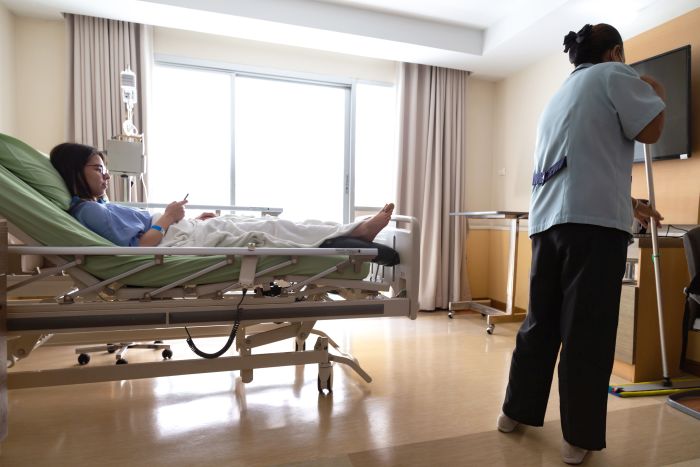
The non-licensed professionals such as food service, laundry, and environmental services (formerly called housekeeping) are faring even worse than their licensed co-workers. Take, for instance, the plight of the environmental services (EVS) staff.
These are the professionals charged with maintaining the facilities in not only a clean, tidy, and attractive manner, but more importantly, keeping the environment hygienic, that is, keep the dirt away and the potential pathogens on surfaces to a level that is not harmful to humans. But, keep in mind, Nursing Home patients are already physically compromised.
Buffy J. Lloyd-Krejci, DrPH, MS, chief executive officer of IPCWELL, worked in hospitals for more than 20 years in various roles. Since 2009, she has worked in epidemiology research, focusing on infectious diseases such as the H1N1 pandemic, then in academia and research with the Mayo Clinic. There, she developed a mathematical model for the human papillomavirus and how it spreads in a population. Over the last six years, she has worked explicitly at a national level with CMS in quality improvement.
She eventually formed her own consulting business with a focus on nursing homes. She studied both academically and at long-term care facilities how to eradicate healthcare-associated infections (HAIs), using data and physical surveillance, and measuring the burdens and challenges experienced in facilities and practical methods to reduce infections.
She has seen the disparities up close and personal.
And it was when she stepped into the front-row seat of the actual infection control practices in nursing homes, the lack of training, the lack of support, the lack of equipment, processes, and procedures of EVS that knew something was grossly amiss. Fortunately, people and the industry were starting to look closer at how EVS encountered the healthcare environment.
New federal mandates were coming out, so she was positioned at the right place at the right time to make a difference. Then she saw a massive gap in infection control practices and procedures and was quite surprised. She couldn’t believe that the same evidence-based practices in acute care were not in place in nursing homes. She asked why long-term care facilities did not implement effective infection prevention programs. How could nursing homes have very sick residents with highly acute conditions to infection, exposed to multidrug-resistant organisms that cause infectious diseases that run rampant not have proper and functioning infection prevention and control (IP&C) programs in place?
Yes, many facilities have excellent infection prevention programs in place, but Lloyd-Krejci observed many problems, not the least of which was no IP program, and this was all before COVID-19. It was the exposure to the reality of many nursing homes’ poor conditions that called her to action to help make a difference.
Interestingly, Lloyd-Krejci had been conducting research on nursing home regulations relating to infection prevention. She notes that the U.S. had its first significant regulations in 1987, which were subsequently revised in 1992. Nursing homes initially didn’t have a lot of accountability, so these facilities did not report many “harm” incidents. Unfortunately, the long-term care industry preferred to police itself and avoided federal- and state-mandated regulations, and they continue to hold those points of view. However, there was and continues to be, a need for more regulations to protect our vulnerable populations. Again, unfortunately, it has become more necessary to have regulations of a punitive nature over the years. And speaking of infection prevention and control, the last updates for rules were in 1992. In 2016, new federal regulations required every skilled nursing facility that was Medicare-certified to have an infection control program; the 2016 law mandated these programs to be in effect not later than November of 2017.
Now, 2017 was just a few years ago. Medicare-certified nursing homes only had to have an infection control program in 2017, and yet many still do not have plans in place. In 2018, long-term care facilities were to have antibiotic stewardship programs in place in November 2019, approximately two months before the COVID-19 pandemic arrived in the U.S. Every Medicare-certified skilled nursing facility was required to have an infection preventionist onsite, at least part-time. However, the term “part-time” is debated and open to broad interpretation by the long-term care industry.
During a live stream broadcast on Feb. 4, 2021, a representative of Direct Supply, Senior Living Advocacy, stated that many for-profit nursing homes are opposed to the requirement of having infection preventionist positions in nursing homes, even part-time. Senior Living Advocacy is hoping to eliminate the Nov. 28, 2019 CMS mandate with the policy-makers in Washington, D.C., so it appears that profits may be more important than the protection of nursing home residents.
When Lloyd-Krejci talked with infection preventionists in nursing homes across the country, most IPs told her they had about five to 10 hours a week devoted to infection control. On a practical basis, that’s not enough time to do be effective. An infection preventionist spends about half of their time on the units with the staff educating, training, providing in-services, and conducting audits. The other half of the time is data surveillance tracking, measuring and assessing the infections present, and implementing the process measures to reduce the nursing staff’s infections. IPs must be present to the team, actively working on implementing evidence-based practices to reduce infections. Being present can be done through data surveillance, assessing and identifying them, establishing data trends, and ascertaining if what is done to reduce or prevent infections is working effectively.
Infection prevention is not a part-time job, and it’s more than a full-time job. Finding full-time infection preventionists for nursing homes is not easy, mainly when owners or corporations are resistant and require the IP to cover numerous facilities. When acute-care hospitals started hiring IPs, they had similar difficulties finding full-time staff. Many of them did not want to accept the reality that infection prevention is a full-time position. Frequently in nursing homes, an IP will wear other hats, such as the staff educator; sometimes they’re the assistant director of nursing or even the director of nursing (DON).
That is inappropriate and unrealistic as both roles — IP and DON — are time-consuming and balancing two disciplines equitably and effectively is impossible. Infection prevention is an enormous responsibility and so wide-ranging. Infection preventionists must be familiar with infectious diseases and microbiology, the nuances of laboratory testing, extensive knowledge of Environmental Services, water management, waste management, building and construction, airflow and air currents, air testing, and a myriad of other professions. Being an effective IP means doing the job, engaging in continuing education, being a good educator for staff, staying up to date with hundreds of regulations, and how to navigate around the smoke and mirrors presented by sales reps and honestly endorsing only that which is needful and useful. New IPs in long-term care rarely have the depth of training, nor do they have the knowledge needed to succeed.
There is synchronicity being embraced by infection preventionists and EVS managers and directors. Past practices in all areas of healthcare have danced around the responsibilities. Each discipline had its own sandbox that was sacrosanct and only invited others into the sandbox to observe but not touch. For EVS personnel and IPs, there is such commonality with each sandbox that they are no longer so sacred and off-limits to each other. Why? Because the emphasis in EVS has changed from cleaning for pleasing surroundings to hygienically cleaning the healthcare environment. Both IP and EVS are now walking hand-in-hand with a singular goal of patient-first outcomes.
With a shared goal being voiced and endorsed by both disciplines, each can benefit from a shared knowledge plateau, with answers to “What needs to be processed, by whom, when, how?” Perhaps the most beneficial outcome of the synchronicity is “Why.” Education and training are being shared and explored by both disciplines. The “why” of things delves into infection prevention, how infections spread, why removal biofilm is so essential, why following a technique and process affects a hygienic environment, and why both disciplines are saving lives. Having answers that people can grasp and explain to others is essential in infection control and EVS.
It is a certainty that there is EVS staff not trained in infection control, and it is a certainty that there is EVS staff not adequately trained in environmental services for hygienic outcomes. A majority of infection control training is concentrated on clinical staff, which is as it should. Still, the EVS and laundry staff are mostly entirely left out of training that teaches the “why” of processing (cleaning and disinfecting). Those views do not advocate educating EVS staff to the level of the clinical team. It is posing the question: “How can people ask for help if they don’t know whom to ask?” “How can they know whom to ask unless someone is sent to them?” “How can they know what to ask if no one tells them what to look for?” “How is an IP supposed to know what to tell the EVS staff if he or she knows nothing about EVS?”
The Environmental Services Optimization Playbook (EvSOP) is available at no cost to IPs, EVS managers and directors, and anyone interested in knowing how to begin successfully, operate, maintain and succeed at managing an EVS department. The Playbook is available at https://www.thepearcefoundation.org/evsop/.
According to Lloyd-Krejci, EvSOP is critical because it offers the toolkit and training, and resources to health care settings to improve infection control practices and therefore reduce their risk and rates of infections.
Lloyd-Krejci is on the frontline of working with nursing homes. She has seen first-hand the pitiful condition EVS departments are in and the pathetic tools they work with while doing their utmost best with what little they have. She tells of one employee who was given two rags — torn towels, actually — to clean all of her rooms. Her supervisor told her to rinse them out when they were dirty. If the employee asked for more wipes or towels with which to perform her job better, her supervisor rebuked her.
It reminds one of Charles Dickens’ character, Oliver Twist, when Oliver said to Mr. Bumble, “Please, sir, I want some more.” The master, Mr. Bumble, aimed a blow with his ladle at Oliver’s head.
Lloyd-Krejci has seen nursing home EVS staff treated almost as shamefully as Oliver Twist when asking for more and better supplies and tools to do their job. She has a warm place in her heart for them because they have a “tough, tough job, and they have very low pay and very, very low respect. So, being able to say to them how important they are, how critical they are to keeping the environment safe and infection-free is, it’s important in all of this work. EVS staff want to do the right thing, but it’s challenging because of a lack of training and on-the-job education. It’s a lack of education and awareness of what needs to be processed, by whom, when, how, and why.
So, every time she gets the chance to show EVS how to properly wear and don/doff PPE, or use the healthcare-grade ultrafine microfiber wipes and mops to properly clean and disinfect the patient environment or process the laundry to the CDC/CMS guidelines, she considers each a small victory in the much larger war that is being fought.
Written by John Scherberger, published in the March 2021 issue of Healthcare Hygiene magazine.