
Use Our Interactive Tool to Locate the Shadows in a Patient room
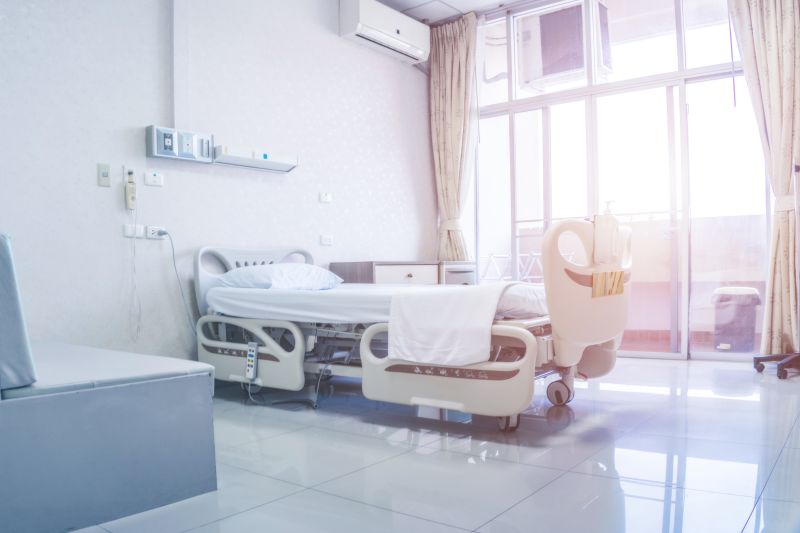
In healthcare facilities where UV-C robot disinfection is employed, shadowing occurs when furniture, equipment, beds, curtains, or other objects block the device’s germicidal UV-C light from reaching a surface. Because UV-C travels essentially in straight lines and does not bend around obstacles, shaded areas may receive little or no germicidal dose.
For example, the underside of a bed, the back of a bedside table, or a surface behind medical equipment may remain untreated even though the robot has completed its cycle. The effectiveness also decreases when the light strikes a surface at an oblique angle or is farther from the lamps.
To reduce shadowing, healthcare facilities typically:
– Move or reposition the robot to expose different sides of the room.
– Open curtains, drawers, and cabinet doors where appropriate.
– Move portable equipment and furniture when safe to do so.
– Use multiple lamp positions or programmed passes.
– Clean surfaces manually first, since dirt/organic material can shield microorganisms.
– Continue routine manual cleaning; UV-C is a supplement, not a replacement.
Thus, a UV-C robot may disinfect exposed surfaces effectively, but its performance should not be interpreted as complete room disinfection unless shadowed areas have also been addressed.
UV-c room Lab: Beat the Shadows
Welcome to an interactive learning tool that helps healthcare teams make better decisions about selecting and deploying UV-C devices for their facilities.
WHAT IT IS
Originally created for the Hands-On Hygiene Skills Fair (station 9: Beat the Shadows), the UV-C Room Lab lets participants explore how distance, angle, shadow and exposure time affect the light reaching surfaces in a room.
The model draws on the UV-C physics described in Wladyslaw Kowalski’s Ultraviolet Germicidal Irradiation Handbook. Through demonstrations and a room-placement challenge, participants learn to recognize coverage gaps, make more informed placement decisions and evaluate whether a UV-C solution fits their environment and workflow.
The tool is educational and vendor-neutral. It models a generic UV-C source, not a specific product, and illustrates relative exposure rather than predicting germ-kill results.
WHO IT’S FOR
– EVS directors, managers and frontline team leads
– Infection preventionists
– Educators running in-services or skills-fair stations
– Anyone evaluating UV-C technologies
WHAT’S INSIDE
The tool runs in three short acts:
Act 1, The Physics: Explore how distance, surface angle and obstacles affect exposure. A reflection myth check explains why you shouldn’t assume light will bounce into shadows.
Act 2, Beat the Shadows: Place one or two UV-C source positions, set the exposure time and see which high-touch points and surfaces you reach. Compare room sizes and try the bathroom door open or closed.
Act 3, Apply It: Take four principles back to your program—Close, Square, Clear, Confirmed—along with questions to ask vendors about validation, studies, data and how their devices handle the physics.
HOW TO USE IT
Open the tool in a modern browser. No installation or login needed.
Explore Act 1, adjusting the sliders to see each principle in action.
Try the room challenge with one source position, then two. Compare placements, exposure times, room sizes and bathroom settings.
Use Act 3 to discuss your own rooms and turnover process, and bring the vendor questions to your next product evaluation or value-analysis meeting.
WHY EVSOP OFFERS IT
Choosing a UV-C solution means understanding how it will perform in the spaces where it will be used. This tool helps teams connect the physics to practical questions: Which surfaces will receive light? Where will shadows remain? What placement and cycle time will fit the workflow? What evidence supports the manufacturer’s claims?
The goal is to help teams select appropriate technology and use it more effectively as an addition to manual cleaning and sanitization.
OPEN ACCESS
The UV-C Room Lab is a teaching tool with a simplified, illustrative room model. Its scores do not represent measured dose or germ-kill results. It does not validate a product or replace manufacturer instructions, facility policies or infection prevention guidance. UV-C supplements manual cleaning and disinfection processes; it does not replace them.